
Fixing the Broken Revenue Stack
Why Most MarTech AI Fails and How to Operationalize It
Executive Summary
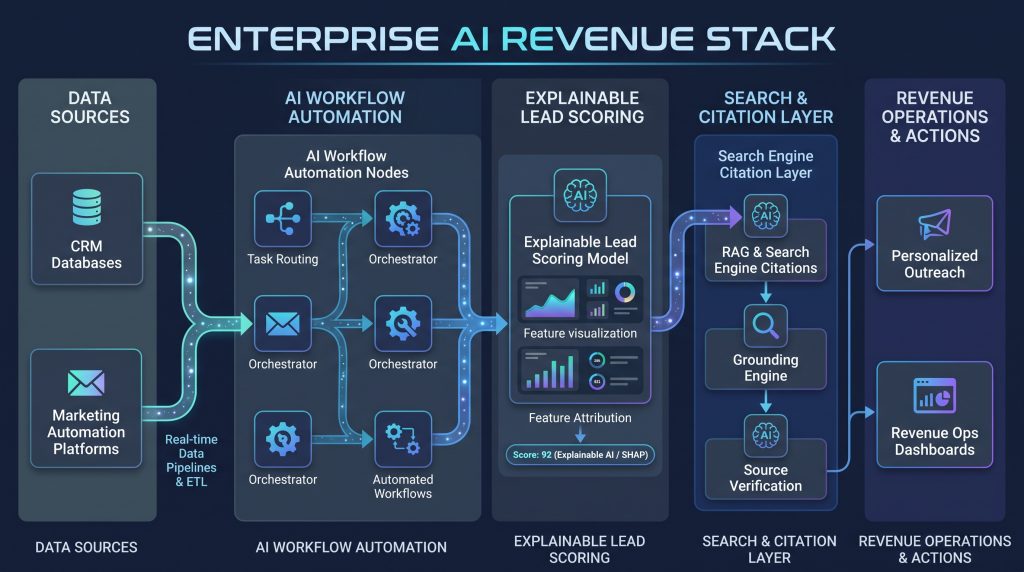
Most enterprise AI initiatives stall not from a lack of models, but because they are deployed on fragmented systems and contaminated CRM data. Real revenue impact requires connecting AI directly into existing platforms (HubSpot, Marketo, Pardot, Salesforce) with explainable logic and human-in-the-loop guardrails. This architecture teardown addresses the core revenue stack bottlenecks and provides a validated deployment framework for automated enrichment, explainable scoring, and search citation visibility.
Core Audience Pain Points vs. AI Service Solutions
- AI Readiness AuditRanked use-case matrix, schema cleanup, 90-day technical roadmap.
- Operational Churn & Manual EntryReps spending 30%+ of time logging calls, research, and data deduplication.
- AI Workflow AutomationAutomated CRM enrichment, meeting task sync, and draft generation.
- Explainable Scoring EngineField-level reasoning logged directly into CRM records.
- AI Search Visibility (AEO/GEO)Structured JSON-LD schema and answer-first content cited by AI models.
- Data Leakage & Compliance RiskUnvetted staff uploading customer PII into public AI models.
- AI Governance & EnablementAir-gapped APIs, human approval gates, role-specific playbooks.ployment framework for automated enrichment, explainable scoring, and search citation visibility.
Prerequisites & Stack
Core Platforms: Salesforce Sales Cloud (Enterprise+), HubSpot Marketing Hub / Marketo Engage.
Middleware & Webhook Ingestion: n8n (Self-Hosted) or AWS Lambda / FastAPI microservice.
LLM Engine: Claude 3.5 Sonnet or OpenAI GPT-4o via enterprise API (zero-data-retention tier).
- Data Layer: Clean REST API access with custom CRM fields defined for
AI_Score_Explanation__candAI_Review_Status__c.
Implementation: Automated Lead Enrichment & Explainable Scoring Pipeline
The following production-grade webhook handler ingests incoming HubSpot/Salesforce lead data, scrubs PII, queries the LLM for firmographic enrichment, calculates a transparent score, and requires manual review for boundary conditions.
Troubleshooting & Edge Cases
CRM Rate Limit Saturation:
Symptom: Webhook retries fail during high-volume event bursts (e.g., webinars).
Resolution: Implement a Redis-backed message broker (e.g., Celery or BullMQ) in front of the FastAPI middleware to cap outbound patch requests to 10 calls/sec.
Scoring Drift & Model Hallucinations:
Symptom: Borderline ICP leads scored as high priority due to inflated prompt responses.
Resolution: Lock model temperature to
0.0or0.1. Define deterministic regex verification over JSON payload schemas before writing to CRM properties.
Customer PII Exposure via Webhook Ingestion:
Symptom: Free-text field entry contains sensitive customer financial or authentication details.
Resolution: Deploy automated regex scrubbing on inbound fields before LLM dispatch. Restrict enterprise API licenses to Zero-Data-Retention (ZDR) contracts.
Conclusion: Stop Piloting Point Tools, Start Engineering the Stack
The divide between AI projects that stall in pilot purgatory and those that drive measurable revenue comes down to architecture: AI cannot fix a broken foundation.
Adding standalone point tools on top of dirty CRM records, disconnected middleware, and unverified data models only accelerates bad data downstream. Real operational efficiency happens when AI is embedded directly into your core systems:
Foundation Over Hype: Fix schema discrepancies, validate inbound payloads, and clean your CRM data before running autonomous scoring.
Explainability Drives Adoption: Sales reps will ignore black-box numbers; write the exact scoring justification directly into custom CRM properties.
Human-in-the-Loop Reliability: Use boundary thresholds to trigger SDR triage on borderline fits, preventing model hallucinations from reaching buyers.
Optimize for Answer Engines: Restructure public-facing technical content and schema so LLMs cite your business as the canonical source.